
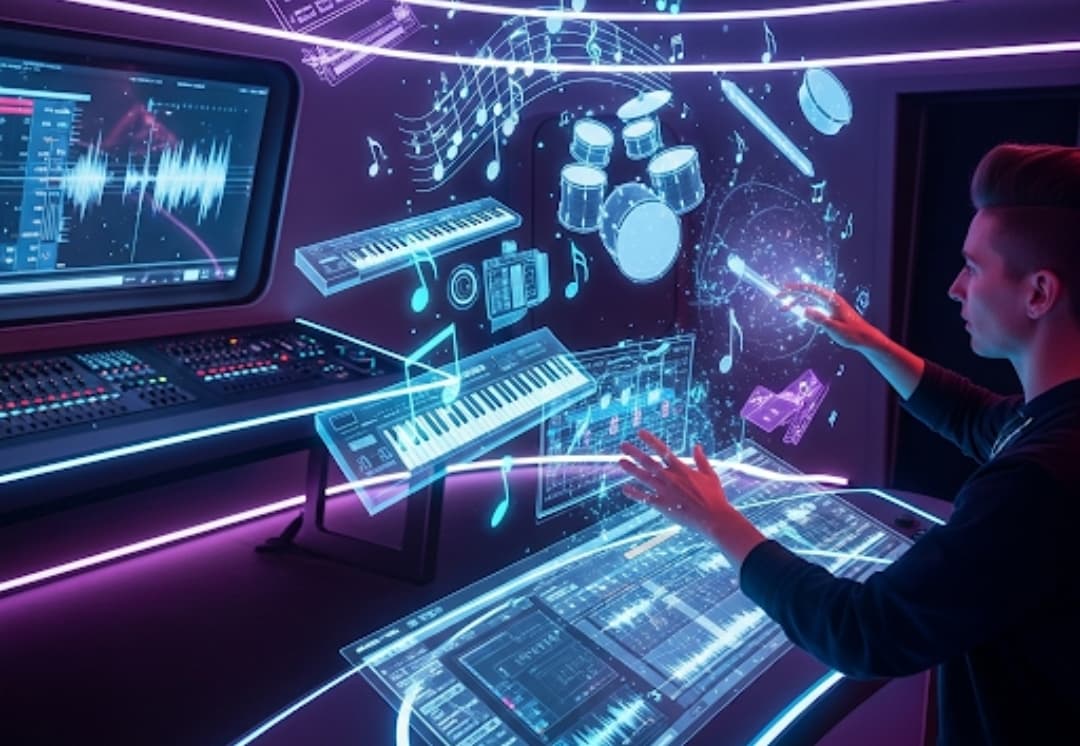
AI Music Generators in 2025: The Next Big Disruption in the Music Industry

I’ll be honest with you: when I first heard about AI making music, I thought it was going to be garbage. Like, how could a computer possibly create something with soul, with feeling, with that indefinable quality that makes music actually move you? But then I spent a few weeks diving deep into what’s happening in 2025, and I have to tell you – I was completely wrong about where this is heading.
The AI music scene isn’t just growing. It’s exploding. And it’s not replacing musicians like everyone feared. Instead, it’s doing something way more interesting.
Let me break down what’s actually happening, why it matters, and what it means for anyone who creates or listens to music.
The Numbers Don’t Lie
First, let’s talk about the sheer scale of what’s happening. Search volume for “AI music generator” is hitting over 200,000 searches per month. That’s not a typo. Two hundred thousand people every month are actively looking for ways to create music with AI.
That’s more than most mainstream music production software gets. More than searches for “how to learn guitar” or “music production courses.” This isn’t a niche thing anymore – it’s mainstream.
And it’s not just curiosity. People are actually using these tools. The major AI music platforms are seeing user growth rates that would make any tech startup jealous. We’re talking 100x year-over-year growth in some cases.
But here’s what’s really interesting: it’s not just hobbyists and experimenters. Professional musicians, major brands, content creators with millions of followers – they’re all using AI music tools now. That tells you something fundamental has shifted.
What Actually Is an AI Music Generator?
Okay, so what are we actually talking about here? An AI music generator is basically a system that uses machine learning – specifically deep learning neural networks – to create original music.
You give it some input. Maybe that’s a text prompt like “upbeat electronic track with 80s vibes.” Maybe it’s a melody you hum. Maybe it’s just selecting a genre and mood from a menu. The AI then generates a complete piece of music based on that input.
The technology behind this is pretty wild. These systems are trained on millions of songs across every genre you can imagine. They learn patterns – not just in melody and rhythm, but in how different instruments work together, how songs are structured, how emotions are conveyed through sound.
In 2025, the technology has reached a point where the output is genuinely impressive. We’re not talking about random beeps and boops. We’re talking about music that sounds professionally produced, with realistic instruments, proper mixing, and actual musical coherence.
Why Is This Blowing Up Right Now?
So why 2025? Why not five years ago, or five years from now? There are a few reasons this is happening right now.
First, the technology finally works well enough to be useful. Early AI music generators were interesting experiments, but the output was pretty limited. You could tell it was AI-generated, and not in a good way. But recent advances in neural network architectures – particularly transformer models and diffusion models – have pushed the quality to a point where it’s actually usable.
Second, the tools have become accessible. You don’t need a PhD in machine learning or a powerful computer anymore. Most of these platforms run in your browser. You type what you want, wait a few seconds, and boom – you have music. That level of accessibility is what turns a cool technology into a cultural phenomenon.
Third, there’s a massive demand for music content. Think about how much content is being created every day. YouTube videos, TikToks, Instagram reels, podcasts, streaming shows, corporate videos, advertisements. All of that needs music. And licensing music is expensive and complicated. AI-generated music solves that problem.
Fourth, the creator economy is huge now. There are millions of people making content professionally or semi-professionally. Most of them can’t afford to hire composers or pay for expensive music licenses. AI music generators give them a way to get custom music that fits their content perfectly, for a fraction of the cost.
Who’s Actually Using This Stuff?
Let me paint you a picture of who’s using AI music generators in 2025, because it’s more diverse than you might think.
Independent musicians are using it to create demos and experiment with ideas. Instead of spending hours programming MIDI or recording scratch tracks, they can generate a rough version of what they’re hearing in their head in minutes. Then they can refine it, add their own playing, and turn it into a finished track.
Content creators – YouTubers, TikTokers, podcasters – are using it for background music. They need music that fits their content, doesn’t have copyright issues, and sounds professional. AI generators give them exactly that.
Brands and marketing teams are using it for commercials, social media content, and corporate videos. They can generate music that matches their brand identity and the specific mood of each piece of content, without going through the traditional process of briefing composers and waiting for revisions.
Game developers are using it to create adaptive soundtracks that change based on gameplay. This is actually one of the coolest applications – music that responds in real-time to what’s happening in the game.
Film and TV producers are using it for temp tracks and sometimes even final scores for smaller productions. The technology isn’t quite at the level where it’s replacing Hans Zimmer, but for a lot of productions, it’s more than good enough.
Even established musicians and producers are experimenting with it as a creative tool. They’re not replacing their skills – they’re augmenting them. Using AI to generate ideas, create variations, or handle the tedious parts of production so they can focus on the creative decisions.
The Tools That Are Actually Good
Let me tell you about the platforms that are actually worth your time in 2025, because there are a lot of options and most of them are mediocre.
SoundMind AI is probably the most impressive for realistic instrument emulation. If you need something that sounds like it was played by actual musicians, this is your best bet. It’s particularly good at strings and piano. A lot of indie artists and YouTubers use this one.
BeatBot is the go-to for electronic music and beats. You select a genre – trap, house, lo-fi, whatever – and it generates beats that actually slap. Podcasters love this for intro music. Brands use it for social media content. It’s fast and the quality is consistently good.
MelodyQ is interesting because it does both lyrics and melody. You can give it a theme or even just a mood, and it will generate a complete song with vocals. The synthetic vocals are getting scary good. Not quite indistinguishable from humans, but close enough that most people can’t tell without listening carefully.
SonicUplink is for people who actually know music production. It integrates with DAWs (digital audio workstations) and lets you collaborate with AI in real-time. You can generate a section, tweak it, generate variations, and build up a track piece by piece. A lot of professional producers are using this as part of their workflow now.
Each of these platforms has its strengths and weaknesses, but they all share one thing: they’re actually useful. They’re not just tech demos. They’re tools that people are using to create real music for real projects.
How Does This Actually Work?
You’re probably wondering how a computer can create music that sounds good. The technical details are complex, but the basic idea is actually pretty straightforward.
These systems are trained on massive datasets of music. We’re talking millions of songs across every genre, style, and era you can imagine. The AI learns patterns from all this music – not just surface-level stuff like “rock songs have guitars,” but deep patterns about how melodies work, how harmonies are constructed, how rhythm creates groove, how different instruments interact.
The really advanced systems in 2025 use something called transformer models. These are the same type of AI architecture that powers ChatGPT and other language models. Turns out, music and language have some interesting similarities – they’re both sequential, they both have patterns and structure, they both convey meaning through arrangement.
When you give the AI a prompt, it’s essentially predicting what music should come next based on everything it learned from its training data. It’s not copying existing songs – it’s generating new music that follows the patterns it learned.
The latest systems also use something called diffusion models, which is the same technology behind AI image generators like Midjourney. This helps create more coherent, higher-quality output.
One of the coolest advances in 2025 is style transfer. You can take a melody and tell the AI to render it in the style of classical music, or jazz, or K-pop, or whatever. The AI understands the characteristics of different styles well enough to translate between them.
Another major advance is real-time collaboration. Some platforms now let you work with the AI interactively. You play something, the AI responds. You tweak what it generated, it adapts. It’s less like using a tool and more like jamming with a very talented, very fast collaborator who never gets tired.
The Controversy Nobody Wants to Talk About
Okay, let’s address the elephant in the room: a lot of musicians hate this technology. And I get it. I really do.
There’s a fear that AI music will flood the market with cheap, generic content and make it even harder for human musicians to make a living. There’s a concern about copyright – these AIs were trained on existing music, often without explicit permission from the artists who created that music. There’s a philosophical question about whether AI-generated music can have the same value as human-created music.
These are legitimate concerns. But here’s what I’ve observed after talking to a lot of people in the music industry:
The musicians who are thriving with this technology are the ones who see it as a tool, not a replacement. They’re using AI to handle the tedious parts of music creation – generating backing tracks, creating variations, producing demos – so they can focus on the parts that require human creativity and emotion.
The musicians who are struggling are the ones who were already struggling. AI didn’t create the problem of music being undervalued and musicians being underpaid. That problem has existed since streaming became dominant. AI is just another factor in an already difficult landscape.
The reality is that there will always be a market for human-created music with genuine emotion and artistry. But there’s also a massive market for functional music – background tracks, commercial music, content music – where the bar is “sounds good enough” rather than “moves me emotionally.” AI is filling that market, and honestly, that’s probably okay.
What’s interesting is that some of the most creative uses of AI music are coming from musicians themselves. They’re not threatened by it – they’re excited by it. They see it as a new instrument, a new way to express ideas.
The Copyright Mess
I can’t talk about AI music without addressing copyright, because it’s a mess and it’s only going to get messier.
Here’s the situation: most AI music generators were trained on copyrighted music. The companies behind these tools argue that this is fair use – they’re not copying the music, they’re learning patterns from it, just like a human musician learns by listening to other music.
Many artists and rights holders disagree. They argue that their work is being used without permission or compensation to create a system that competes with them.
As of 2025, this is still being fought out in courts. There have been some lawsuits, but no definitive legal precedent yet. Different countries are taking different approaches.
For users of AI music generators, the practical question is: can you actually use the music you generate? The answer depends on the platform. Most of the major platforms give you a license to use the music you generate, at least for certain purposes. But the terms vary widely.
If you’re creating content commercially, you need to read the fine print carefully. Some platforms give you full commercial rights. Others only allow personal use. Some require attribution. Some have revenue limits.
The safest bet right now is to use platforms that either trained their AI on licensed music or on music that’s in the public domain. There are a few of these, though they’re generally not as good as the ones trained on everything.
This is going to be a major issue for the next few years. My prediction is that we’ll eventually see some kind of licensing system where AI companies pay into a fund that compensates artists whose work was used in training. But we’re not there yet.
What This Means for the Future of Music
So where is this all heading? What does music look like in a world where AI can generate professional-quality tracks in seconds?
I think we’re going to see a split in the music world. On one side, you’ll have human-created music that emphasizes artistry, emotion, and the human connection between artist and listener. This music will be valued specifically because it’s human-made. People will pay for it, go to concerts, buy merch, support the artists.
On the other side, you’ll have AI-generated music that serves functional purposes. Background music for content, commercial music, ambient music, music for specific moods or activities. This music won’t be about artistic expression – it’ll be about utility. And that’s fine. Not all music needs to be art.
The interesting space is in the middle. Musicians using AI as a tool to enhance their creativity. AI-human collaborations where the human provides the vision and emotion, and the AI handles the technical execution. New forms of music that wouldn’t be possible without AI.
I also think we’re going to see music become more personalized. Imagine music that’s generated specifically for you, based on your mood, your preferences, your current activity. Your own personal soundtrack that adapts in real-time to your life. That’s not science fiction – the technology to do this exists now. It’s just a matter of someone building the right product.
We’re also going to see music become more interactive. Games and virtual worlds where the music responds to what you’re doing. Fitness apps where the music adapts to your workout intensity. Meditation apps where the music evolves based on your biometric data.
The democratization of music creation is going to continue. Right now, creating professional-quality music requires years of training and expensive equipment. With AI, that barrier drops dramatically. Anyone with an idea can create music. That’s going to lead to an explosion of creativity, but also a lot of noise. Curation and discovery will become even more important.
Should You Try It?
If you’ve read this far, you’re probably wondering whether you should actually try using an AI music generator. My answer: yes, absolutely.
Even if you’re not a musician, even if you have no plans to create content, it’s worth experiencing just to understand what’s possible. It’s genuinely mind-blowing the first time you type a description and hear music that matches it appear out of nowhere.
If you are a content creator, this is a no-brainer. The ability to generate custom music that fits your content perfectly, with no copyright issues, for a fraction of what licensing would cost – that’s huge.
If you’re a musician, I’d encourage you to approach it with an open mind. Don’t think of it as a threat. Think of it as a new tool. Experiment with it. See what it can do. You might find it sparks ideas you wouldn’t have had otherwise.
Most of the major platforms have free tiers that let you generate a certain amount of music per month. Start there. Play around. See what works for you.
The Bottom Line
AI music generators are not a fad. They’re not going away. The technology is only going to get better, the tools are only going to get more accessible, and the adoption is only going to increase.
This doesn’t mean the end of human musicians. It doesn’t mean all music will be soulless AI-generated content. What it means is that music creation is becoming democratized in a way that’s never been possible before.
The musicians who thrive in this new landscape will be the ones who embrace the technology while maintaining their human creativity and emotional connection with their audience. The ones who use AI as a tool to enhance their work, not replace it.
For everyone else – content creators, brands, hobbyists – AI music generators are opening up possibilities that didn’t exist before. Custom music for any purpose, generated in seconds, at a fraction of traditional costs.
We’re living through a fundamental shift in how music is created and consumed. It’s messy, it’s controversial, and it’s exciting as hell.
The future of music isn’t human OR AI. It’s human AND AI, working together in ways we’re only beginning to explore.
Now if you’ll excuse me, I have some AI-generated beats to experiment with.